
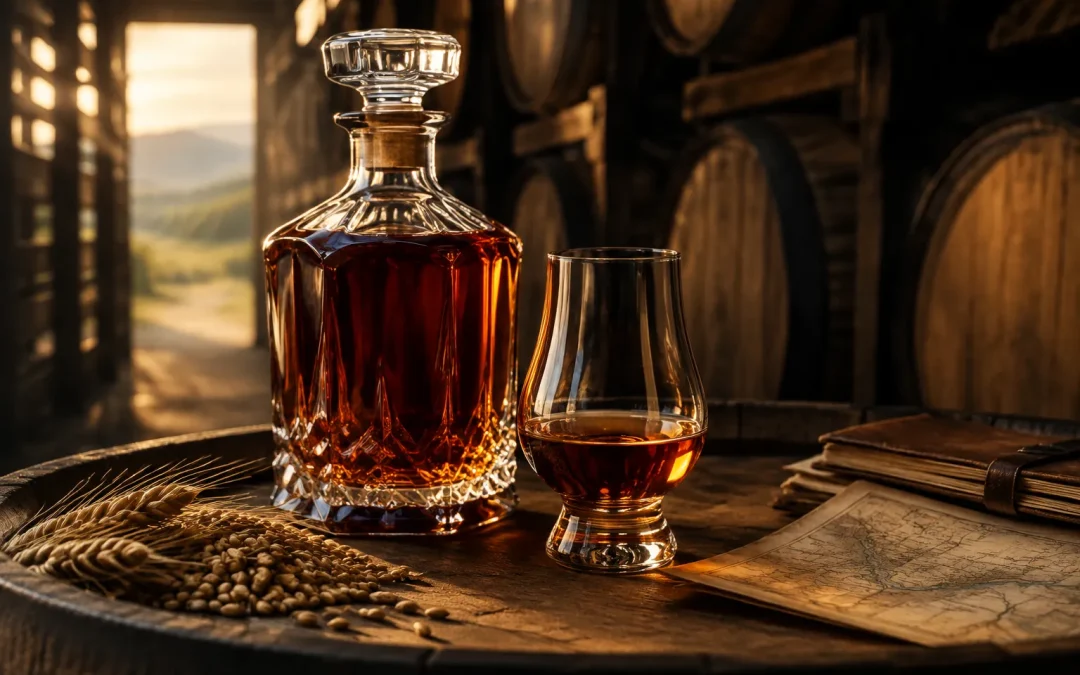
O.F.C. Vintages is Buffalo Trace’s series of bourbon bottles marked with the year their whiskey was distilled. The dates reach back decades, but they are not interchangeable with age statements: a 1995 vintage tells you when distillation began the story, not when the whiskey left its barrel.
The series also carries an older date in its name. It honors the O.F.C. Distillery that preceded Buffalo Trace on the same Frankfort, Kentucky, site. Understanding those two timelines—the distillery’s history and each bottle’s history—is the best way to make sense of O.F.C.
At a glance
- Producer: Buffalo Trace Distillery in Frankfort, Kentucky.
- O.F.C. refers to the historic Old Fashioned Copper Distillery name.
- The year on a bottle identifies its distillation year, not its age.
- The first release went to nonprofit organizations rather than retail sale.
- Documented vintages include 1980, 1982, 1983, 1985, 1989, 1990, 1993, 1994 and 1995.
- Presentation includes a crystal bottle and a wooden box with a year-specific provenance card.
The name behind the bourbon
According to Buffalo Trace’s historical timeline, Colonel Edmund Haynes Taylor Jr. named the site O.F.C. in 1870. The distillery connects those initials to a belief in old-fashioned, wood-fired copper stills; its O.F.C. brand page calls the historic name Old Fashioned Copper. The name is a reference to the former distillery, not evidence that today’s vintage releases were made on 19th-century equipment.
The site had a working distillery before Taylor arrived. He expanded it, and George T. Stagg purchased O.F.C. in 1878 while Taylor continued to oversee operations. It later operated under the George T. Stagg name; Buffalo Trace dates the adoption of its present name to 1999.
That chronology matters when reading a bottle. Bourbon distilled there in 1985 or 1995 predates the Buffalo Trace name, but it does not predate the modern distillery. O.F.C. Vintages uses a historical name to connect whiskey made at the site across its changes in ownership and identity.
From charity bottles to retail releases
The first O.F.C. Vintage release was unusual even by limited-bourbon standards. Buffalo Trace says it supplied 200 bottles at no charge to nonprofit organizations: 100 dated 1980, plus 50 each dated 1982 and 1983. The organizations could use them to raise funds. That arrangement is worth distinguishing from the later releases offered for sale.
In 2018, Buffalo Trace announced its first retail O.F.C. release: bottles distilled in 1985, 1989 and 1990. Its release announcement says each vintage came from a single barrel. The 1985 barrel yielded 61 bottles, the 1989 barrel just 18, and the 1990 barrel 63. Those figures explain the scarcity of those particular bottlings; they should not be treated as the size of every O.F.C. release.
The series continued with 1993, 1994 and 1995 vintages. For the 1995 edition, Buffalo Trace reported 1,500 bottles and said the bourbon had spent 25 years aging before its 2020 release. Its producer-provided tasting notes describe cherry cordial, caramel and lightly smoked oak on the nose, followed by dark chocolate, dates and tobacco-leaf notes on the palate. Those notes describe that vintage, not a verified flavor profile for the entire series.
Nor should a 25-year-old example become a rule for every bottle bearing the O.F.C. name. Buffalo Trace also identified an O.F.C. Vintage 2006 bottle in a 2025 charity fundraiser. The year 2006 identifies when that whiskey was distilled; it does not, by itself, establish its exact barrel age or bottling date.
What the bottle tells you—and what it doesn’t
O.F.C.’s presentation makes the historical theme visible. Buffalo Trace describes a hand-cut crystal bottle with real copper lettering and a hand-applied paper label, housed in a wooden display box. A provenance card lists events from the distillation year. Those details help identify the edition and explain the design, but the card’s historical milestones are not production records.
The most useful first question about any O.F.C. bottle is therefore simple: which year is on it? From there, look for a release announcement specific to that vintage. It may establish a bottle count, an aging period or a producer-provided description that the general series page cannot. Details documented for a single barrel in 2018, for example, should not be carried over to the larger 1995 release.
It is also worth keeping age separate from elapsed calendar time. The Alcohol and Tobacco Tax and Trade Bureau defines whiskey’s age by its time in qualifying oak containers after distillation and before bottling. A bottle distilled in 1995 does not keep gaining age on a shelf after it has been bottled. Without documentation for the particular edition, subtracting its printed year from today’s date will give the wrong answer.
O.F.C. Vintages is most useful to understand as a series of distinct releases, not one bourbon with one age, proof or set of tasting notes. The historical name explains where it comes from; the vintage points to a particular distillation year. For everything else, the specific bottle and its documented release are the places to start.
Sources
- Buffalo Trace Distillery: O.F.C. Vintages
- Buffalo Trace Distillery: Our History
- Buffalo Trace: 2018 O.F.C. Vintage release announcement
- Buffalo Trace: 1995 O.F.C. Vintage release announcement
- Buffalo Trace: Pour It Forward for Kentucky announcement
- Alcohol and Tobacco Tax and Trade Bureau: Distilled Spirits FAQs