
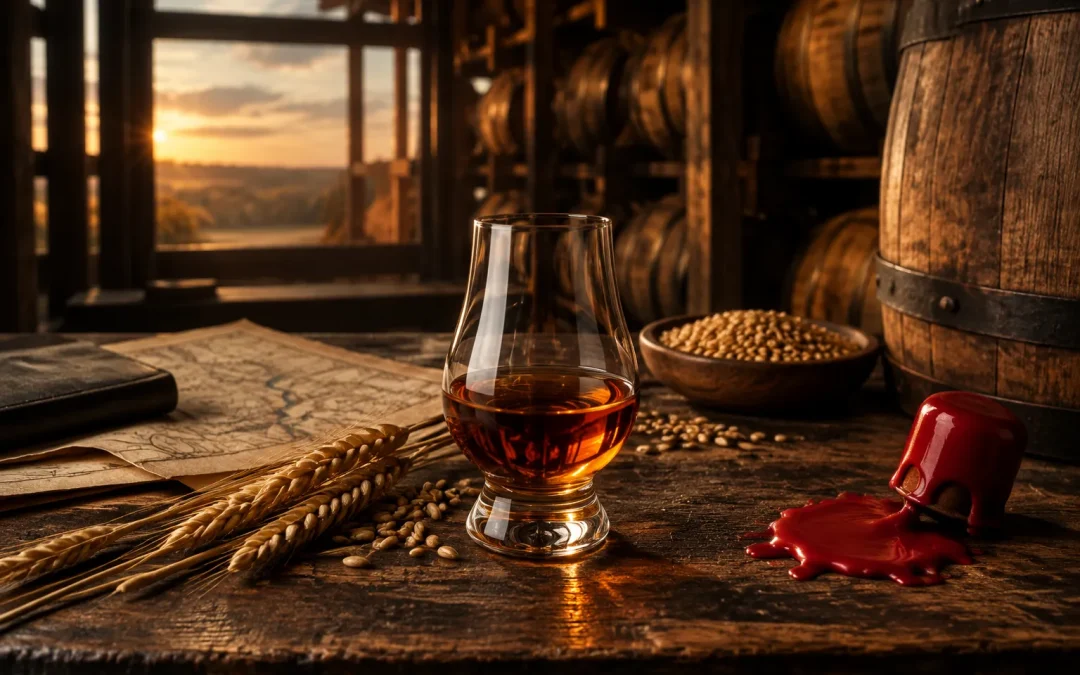
The red wax makes Maker’s Mark easy to recognize. The more useful clue to what is inside the bottle is red winter wheat: the distillery uses it in place of rye in its flagship bourbon recipe.
That choice helps explain Maker’s Mark’s softer style, but it is only part of the story. Barrel aging, bottling proof and the Samuels family’s approach to packaging all shaped the bourbon that carries the name today.
At a glance
- Maker’s Mark Kentucky Straight Bourbon is bottled at 90 proof, or 45% alcohol by volume.
- Its grain recipe uses red winter wheat rather than rye.
- The distillery says it ages the bourbon to taste, usually for six to seven years, rather than to a fixed age.
- Margie Samuels devised the name, bottle design and red-wax finish; the first bottle was dipped in 1958.
- The brand belongs to Suntory Global Spirits, not to a family-owned spirits company.
Why the wheat matters
Bourbon must be made from a grain mixture containing at least 51% corn. Maker’s Mark’s distinguishing choice is what accompanies that corn: according to its account of its production process, founder Bill Samuels Sr. chose soft red winter wheat where many bourbon makers use rye. That makes Maker’s Mark a wheated bourbon, not a wheat whiskey.
Wheat does not guarantee that every drinker will find a bourbon sweet or gentle. It does, however, provide a useful starting point when comparing styles: someone accustomed to the more pointed spice of a rye-recipe bourbon may find Maker’s Mark’s profile comparatively rounded. The oak still has a substantial role to play.
The distillery describes a process that includes limestone-influenced water, fermentation with its established yeast strain and double distillation. It also says the new American white-oak barrels are made from wood seasoned outdoors before the barrels are charred. These are production choices worth noting, but none is a shortcut to an objective ranking of bourbons.
Maker’s Mark says it rotates barrels by hand to manage their exposure to different temperatures within the warehouse. Rather than assign its flagship a fixed age, it says it judges maturity by taste; that generally takes six to seven years. “Usually” matters here: it is not the same as a promise that every bottle contains bourbon aged for a particular number of years.
There is a legal distinction as well. As the Alcohol and Tobacco Tax and Trade Bureau explains, an age statement is generally optional for whiskey aged at least four years, while the age of bourbon refers to time spent in new charred oak. The absence of a number on Maker’s Mark’s front label should not be read as evidence that it is young—or as proof of an exact age.
The story behind the red wax
Maker’s Mark dates its distillery venture at the present site to 1952. In the company’s telling of its family history, Bill Samuels Sr. ceremonially burned an old family recipe in 1953 while pursuing a different bourbon. That burning is part of the brand’s origin story; the firmer production milestone is the first finished, hand-dipped bottle in 1958.
Margie Samuels deserves more than a footnote to that history. Maker’s Mark credits her with the name, bottle shape, label design and red wax. The wax became a visual signature, not a demonstrated explanation for how the bourbon tastes. There is no need to attribute special cork-preserving or airtight properties to the dip to understand why it matters to the brand.
The Samuels family remained central to the whiskey’s identity: Bill Samuels Jr. took over its stewardship in 1975, according to Maker’s Mark. But family stewardship is different from family ownership. Maker’s Mark is among the brands of Suntory Global Spirits, the spirits company formed after Suntory acquired Beam Inc. in 2014.
What to expect from the flagship
The standard bottle is Maker’s Mark Kentucky Straight Bourbon at 90 proof. Its producer-provided tasting notes describe sweet oak, vanilla, fruit and wheat on the nose; oak, vanilla and fruit on the palate; and a creamy finish with soft spice. Those notes describe the producer’s intended profile, not a firsthand tasting or a promise about what any individual will perceive.
For a practical comparison, focus on the balance rather than the wax. If a bourbon with prominent rye spice is your reference point, Maker’s Mark offers a way to explore a wheat-recipe alternative while retaining the oak and corn foundation of bourbon. At 90 proof, the flagship is also distinct from the brand’s higher-proof expressions; the number on the label is a clearer guide to that difference than the bottle’s appearance.
Maker’s Mark 46 takes another route. The producer says it starts with fully matured Maker’s Mark and adds a finishing period with ten seared French-oak staves; it is bottled at 94 proof. Its producer-provided notes emphasize caramel, vanilla and baking spice. It is a separate expression, not an age statement or a revised name for the original bourbon.
Maker’s Mark is most useful to understand on its own terms: a 90-proof wheated bourbon whose makers aim for a softer profile, aged according to their assessment of the whiskey rather than a fixed number on the label. The wax tells a compelling design story. The wheat and the barrel tell you more about the drink.