
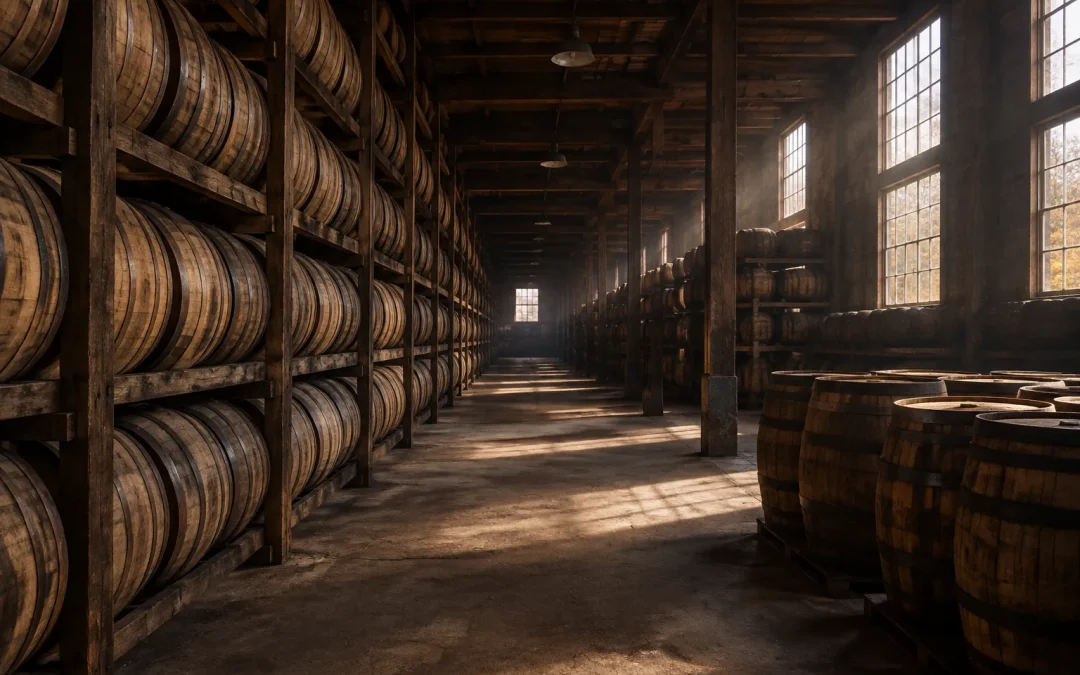
The Kentucky bourbon production decline is now visible in statewide barrel counts. In a report published November 23, 2026, the Kentucky Distillers’ Association said distillers filled 2.13 million barrels in 2025, down from just over 3 million in 2024. Yet Kentucky ended the reporting period with 16.6 million barrels of bourbon aging—more than before.
Those numbers sound contradictory only if new production and existing inventory are treated as the same thing. They are not. The useful question for bourbon drinkers is what a smaller year of barrel filling might mean several years from now, when those barrels would otherwise have reached bottling age.
What the Kentucky bourbon production decline measures
The association describes the change as roughly a 30% reduction in freshly filled barrels and says 2025 production was the lowest since 2019. Its November announcement draws on inventory reports filed by Kentucky distilleries and warehouse operators with the state Department of Revenue as of January 1, 2026. In other words, November 23 was the announcement date; it was not the date of a sudden production cut.
There is an important wording distinction. The new announcement discusses a cut in bourbon production but calls the 2.13 million figure “total production.” The association’s earlier 2026 economic-impact summary describes the comparison year as more than 3 million bourbon barrels filled in 2024. These are statewide production figures, not a tally of bottles shipped to stores, and they do not show how much any individual distillery reduced its output.
That matters because a change in barrels filled today works through an aging business slowly. It does not establish that a favorite established bourbon is about to disappear. Nor does it identify which recipes, age ranges or brands might be affected when the smaller 2025 vintage matures. Those conclusions would require producer-level information that the statewide figures do not provide.
Why aging inventory rose while filling slowed
At the January 1, 2026 reporting point, Kentucky held 17.5 million barrels of aging spirits, including 16.6 million barrels of bourbon. For comparison, the association’s October 2025 inventory announcement, based on reports as of January 1, 2025, counted 17.1 million barrels of aging spirits and 16.1 million barrels of bourbon. Production can fall while inventory rises if barrels continue to enter warehouses faster than existing barrels leave them. The statewide totals show the result; they do not provide a complete account of every movement into or out of storage.
The association attributes slower sales to several pressures, including trade uncertainty and competition for consumer spending. That is its interpretation, not a breakdown proving how much each factor contributed. The central distinction remains simpler: production is a flow of newly filled barrels over a year; inventory is a count of barrels still aging at a particular point in time.
Kentucky’s sizable stock also includes whiskey made across multiple years. It cannot be read as a single batch awaiting release, and not every aging spirits barrel is bourbon. The difference between the 17.5 million total and the 16.6 million bourbon count is worth keeping in view whenever a broad “whiskey inventory” figure appears in a bourbon headline.
Exports and barrel taxes add context, not an easy forecast
The November association report says exports of Kentucky bourbon and other whiskies fell 11% in the first half of 2026 compared with the same period in 2025. It also reports a 40% drop in exports to the European Union through June. Those figures concern exports, not all bourbon sales, and the export category includes other whiskies. They help explain why producers are watching demand, but they cannot establish what will happen to a particular bottle’s availability or shelf price.
The same report puts state and local taxes on aging barrels at a record $83 million. Its previously published economic-impact summary put the earlier figure at $75 million. More barrels can create a larger aggregate tax burden even during a year when distillers fill fewer new ones. The association advocates for tax relief, so its policy argument should be distinguished from the reported inventory and tax totals.
For Kentucky communities, production decisions reach beyond the whiskey aisle. Grain purchases, cooperage, warehousing and other work are tied to what distillers make and hold. The association’s 2024–2025 economic-impact study explains why adjusting output is unusually difficult for aged spirits: distillers must make whiskey now against expectations of demand years later. That long lead time is why a production cut is consequential, even though its effect on finished bottles cannot yet be specified.
What drinkers can watch next
The next informative figures will be subsequent production, inventory and sales reports—not assumptions drawn from one year’s filling count. If new-barrel production remains lower while aging stocks begin to shrink, that would describe a different balance from the one reported this week. If inventories keep rising, it would suggest that the adjustment is taking longer. Neither outcome, by itself, would settle questions about an individual brand’s quality, price or distribution.
There is also no statewide 2026 production total in this announcement. Association president Eric Gregory says he expects production to fall further in 2026, but that is a forecast, not a reported result. The distinction is especially important when a November 2026 headline is discussing production that occurred during 2025.
The bottom line: Kentucky filled substantially fewer barrels in 2025 while its aging bourbon inventory continued to grow. That is a meaningful shift in how the industry is preparing for future demand, not evidence of an immediate bottle shortage. The scale of the change is known; its eventual effect on specific bourbons is not.
Sources were checked at the time of publication. Availability and pricing can change.