Russell’s Reserve Camp Nelson D is the fifth release in the brand’s Single Rickhouse series. Announced on October 6, 2026, it brings barrels from five floors of one Kentucky warehouse into a bourbon bottled at 120.8 proof. Its suggested retail price is $300 for a 750-milliliter bottle. Those are useful specifics. They do not, by themselves, tell us how the bourbon tastes or whether a drinker will find it compelling.
The news is the barrel selection. Rather than drawing from a narrow part of the warehouse, the team selected barrels from floors one, three, four, five, and six. That gives curious bourbon drinkers a concrete question to consider: how much can a blender vary the selection within a single rickhouse while still making that building the defining idea of a release?
Russell’s Reserve Camp Nelson D: The confirmed details
The Breaking Bourbon release calendar lists Camp Nelson D at 120.8 proof and $300. The producer’s announcement describes it as a non-chill-filtered bourbon bottled at barrel proof. Barrel proof means the stated strength is the bottling strength; it is not an age statement or a measure of quality. Non-chill filtration describes a processing choice, not a promise about what any particular drinker will notice in the glass.
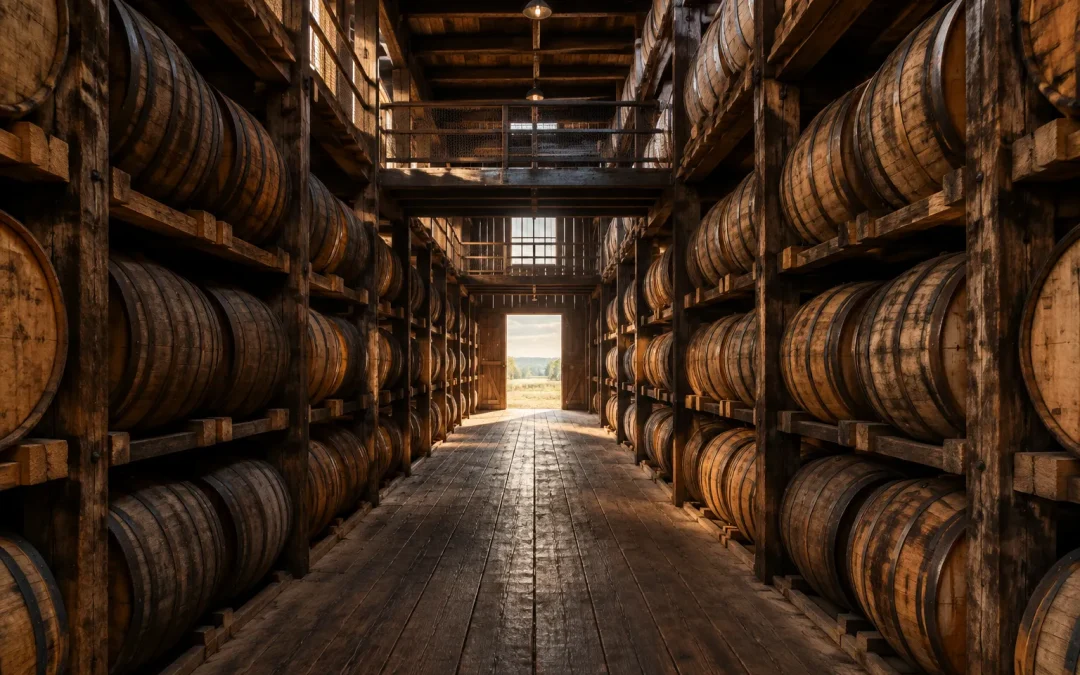
According to the Russell’s Reserve announcement, published by Breaking Bourbon, Camp Nelson D was built in 1946. The producer describes it as the highest-elevation rickhouse featured in this series so far. It says the building’s exposed, west-facing position creates consistent airflow. These are descriptions of the aging site; the announcement does not publish measurements that would let readers isolate airflow’s contribution to the finished blend.
The same announcement says the release is available for a limited time at select retailers in U.S. markets and at the Wild Turkey Distillery Visitor Center. “Select retailers” does not mean every state or store will receive bottles. The announcement does not identify participating states, give a bottle count, or promise continuing inventory at the visitor center. The $300 figure is a suggested retail price, not a verified shelf price.
Why the five-floor selection matters
A single-rickhouse bourbon is not necessarily a single-barrel bourbon. This release combines barrels chosen from five floors of Camp Nelson D. By contrast, Wild Turkey describes Russell’s Reserve Single Barrel Bourbon as individually bottled from a selected barrel at 110 proof. The names point to different selection methods: one warehouse can supply a blend, while one barrel supplies a single-barrel bottling.
The floor spread is also a meaningful change within the Single Rickhouse series. For the 2025 Camp Nelson E release, the producer said it selected barrels exclusively from that warehouse’s fifth floor. Camp Nelson D draws from more floors than any earlier edition, according to the 2026 announcement. That contrast tells us something about how the team built each bourbon. It does not establish that either method produces a better one.
The producer attributes a rye-like spicy character to the new blend and describes the first-floor barrels as contributing an earthy element. Those are the team’s reported impressions, not independently verified tasting findings. More importantly, “rye-like” is a flavor comparison. It does not change the whiskey’s identity into rye whiskey or disclose the exact grain recipe used for this release.
What the warehouse story can—and cannot—show
The Single Rickhouse concept makes the aging location unusually visible. Its 2022 debut, Camp Nelson C, drew from floors three and four of one warehouse and carried a statement that it had aged for more than 10 years. The 2025 edition narrowed its selection to one floor of Camp Nelson E. This year’s edition widens the selection across Camp Nelson D. Those choices give readers a way to understand what changes from release to release beyond a new warehouse letter.
They do not create a controlled experiment. Different barrels and different blending decisions enter each annual release. If drinkers perceive a difference between Camp Nelson D and Camp Nelson E, the announcements alone cannot tell them precisely how much came from the buildings’ positions, the floors selected, the barrels themselves, or the final blending. The warehouse is an important part of the producer’s account, but the available information cannot quantify its effect.
Proof adds another complication for anyone comparing bottles. The 2025 Camp Nelson E announcement stated 128 proof, versus 120.8 for Camp Nelson D. That numerical difference is confirmed. A prediction that the new release will therefore taste milder, spicier, or more balanced would be an inference, not a finding from these specifications.
What remains unknown for bourbon drinkers
The 2026 announcement supplies no age statement for Camp Nelson D and no barrel or bottle count. The age given for the 2022 Camp Nelson C release must not be carried over to this bottle. Nor does the $300 suggested price reveal what a local retailer will charge. Those gaps matter most to people comparing annual editions by maturation, production size, or actual cost.
For readers interested in Kentucky distillery visits, the announced visitor-center availability is worth separating from a guaranteed opportunity to purchase. The release notice does not say how long bottles will remain there. Our Kentucky Bourbon Trail planning guide can help with the broader logistics of a visit, but it cannot verify a particular bottle’s stock.
Russell’s Reserve Camp Nelson D is a clearly specified new chapter in a series built around warehouse selection: one rickhouse, five contributing floors, 120.8 proof, and a $300 suggested price. What the announcement cannot establish is the quality of the finished bourbon or the exact sensory effect of its aging location. For now, the useful distinction is between the producer’s documented choices and the conclusions only a properly evaluated bottle could support.
Sources were checked at the time of publication. Availability and pricing can change.