Four Roses Chestnut bourbon is the distillery’s third Experimental Series release, announced on October 29, 2026. It starts with six-year-old OBSK bourbon and spends an additional five to eleven weeks in chestnut barrels. The announcement gives drinkers unusually specific information about the finishing process, but it does not establish how the whiskey tastes in the glass—or whether many people will be able to find it. Four Roses confirms the recipe, age and proof; its October 29 producer announcement, published by Breaking Bourbon, supplies the finishing and launch details.
What is Four Roses Chestnut bourbon?
Experimental Series No. 003: Chestnut uses Four Roses’ OBSK recipe, aged six years before finishing. Four Roses says it bottled the release at 104 proof, or 52% alcohol by volume. It is a finished expression of an existing Four Roses bourbon recipe, not a newly disclosed mash bill or a blend of several named recipes. The distillery’s product page identifies OBSK, the six-year age and 104 proof; the producer announcement describes the finishing method.
Those letters matter if you follow Four Roses recipes. OBSK combines the distillery’s rye-forward B mash bill with its K yeast strain. The distillery describes OBSK as one of its spicier recipes. That is useful context for why Four Roses chose this base, but it is not a prediction that the finished bottle will taste a particular way to every drinker. Four Roses’ explanation of OBSK sets out the recipe.
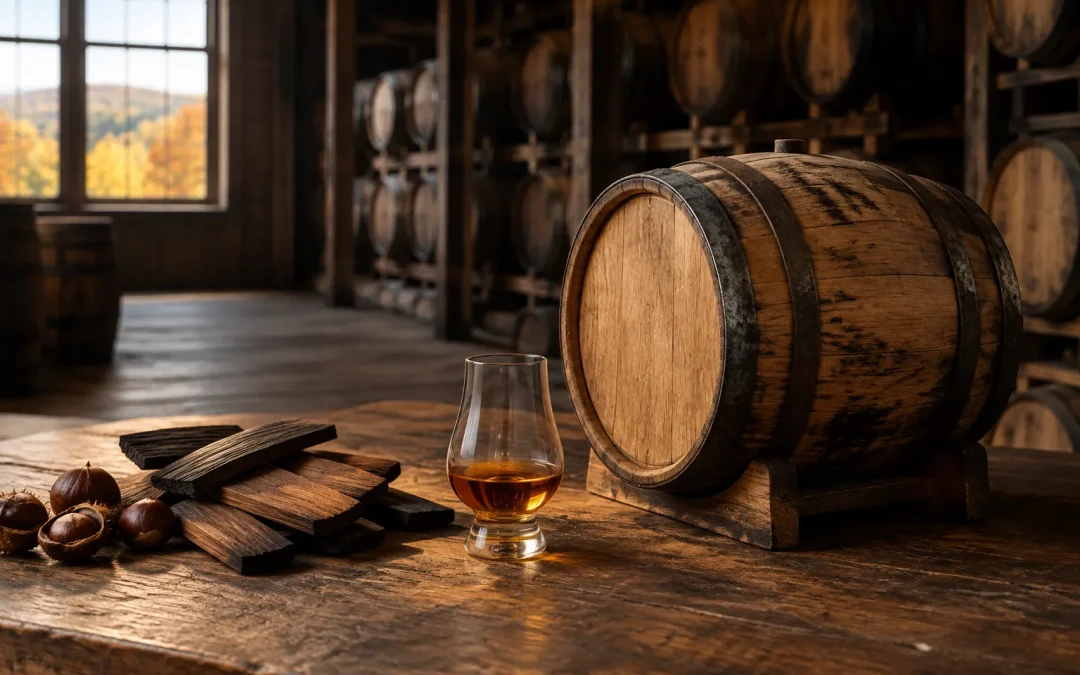
Four Roses says it tested different woods against its ten bourbon recipes before choosing chestnut and OBSK. For the release, it transferred mature bourbon into 250-liter chestnut barrels made from wood grown in Japan. The barrels had different toast and char levels. According to the producer, individual barrels were sampled and emptied at different points, leaving finishing periods ranging from five to eleven weeks. Japanese-grown wood describes the finishing barrel’s material; it does not mean this is Japanese whisky or that the bourbon was finished in Japan. The October 29 announcement provides those production details.
Why the chestnut finish is worth examining
The specific wood and short, variable finishing window make this a more informative announcement than a release described only as “wood-finished.” Four Roses is identifying both the starting recipe and how it handled the finishing barrels. It has not, however, published the number of barrels selected, the total bottle count or the proportion of barrels from each toast and char treatment. Those omissions limit what anyone outside the distillery can conclude about the finished batch’s makeup. The producer announcement details the process without providing those totals.
The six-year figure describes the underlying bourbon; the additional chestnut period is measured in weeks. Readers should not interpret “six years” as six years in chestnut, nor treat a longer finish within the stated range as automatically preferable. Four Roses presents fruit, vanilla and toasted-wood descriptions in its release materials, but those are the producer’s characterizations, not independently verified tasting findings. The product page states the age, while the announcement gives the finishing range and producer tasting descriptions.
This is also a distinct experiment within the series rather than a repeat of its first two releases. Four Roses identifies No. 001 as a Mizunara-oak finish and No. 002 as bourbon finished in barrels previously used for its bourbon-barrel-aged honey. Chestnut uses a different wood and, according to the new announcement, a five-to-eleven-week finishing window. Comparing those stated methods is useful; assuming they produce a quality ranking would go beyond the available evidence. Four Roses’ series overview describes the earlier releases, and its new announcement describes No. 003.
Price, bottle size and the November 20 launch
Four Roses says sales are scheduled to begin November 20, 2026, while supplies last, at its visitor centers in Lawrenceburg and Cox’s Creek, Kentucky. The suggested retail price is $55 for a 375-milliliter bottle—not a standard 750-milliliter bottle. As of November 2, that launch date is still ahead. The announcement names those two Kentucky locations; it does not announce a broader retail rollout or specify how many bottles either site will receive. The producer’s October 29 release notice sets out the date, locations, size and suggested price.
The half-size format matters when comparing shelf prices: two 375-milliliter bottles equal the volume of one 750-milliliter bottle, so $55 for this release is not directly comparable to $55 for a full-size bottle. That arithmetic says nothing about its quality. For a reader outside Kentucky, the more immediate limitation is geographic: the announced purchase locations are visitor centers, and the release notice offers no confirmed distribution plan beyond them. Four Roses’ release details support the stated size, price and locations.
What remains unknown
The announcement does not give a bottle count, a per-customer limit, an allocation for each visitor center or a plan for sales after the initial visitor-center launch. It also does not provide independent tasting evidence. Those are meaningful gaps for anyone trying to judge access or compare the result with other finished whiskeys; neither limited availability nor unusual wood can answer the question of how well the finish works. The announced release terms establish what Four Roses has—and has not—specified.
Four Roses Chestnut bourbon is most relevant as a clearly documented variation on OBSK: six-year-old bourbon, a chestnut-barrel finish and 104 proof, with a scheduled Kentucky visitor-center launch on November 20. The specifications make the experiment understandable. They do not settle its flavor or its availability once sales begin. Four Roses’ product page and release announcement provide the confirmed details. For more context on other recent launches, see our October 2026 bourbon news roundup.
Sources were checked at the time of publication. Availability and pricing can change.