
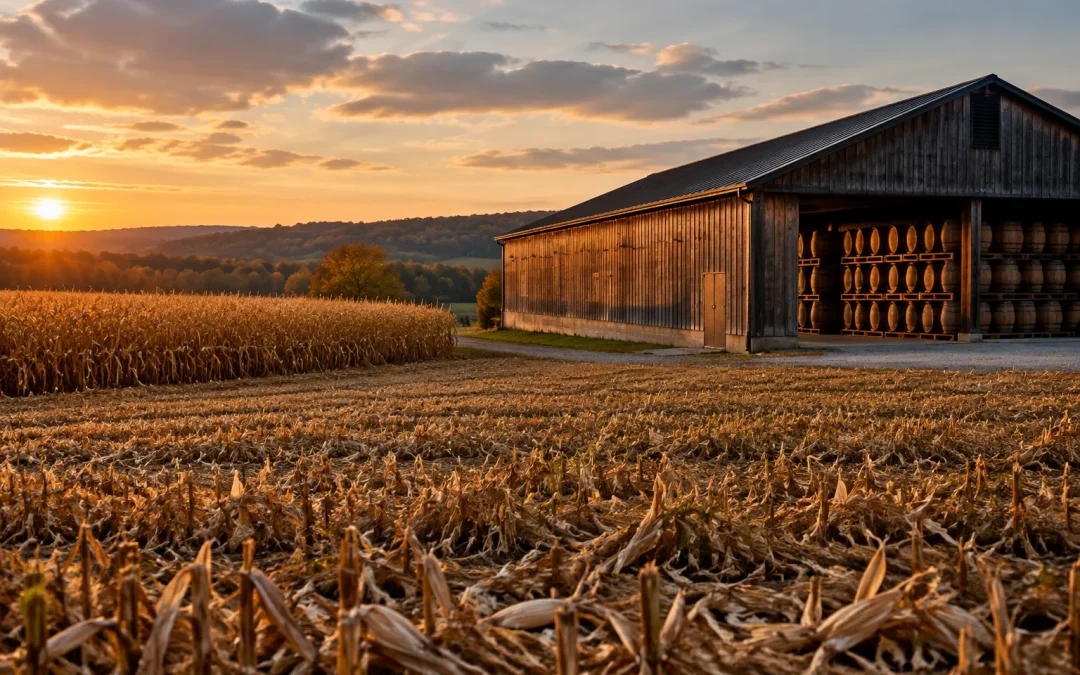
The Starlight estate bourbon 2026 offers a useful question for bourbon drinkers: what does it mean when a distillery says a whiskey comes from its own land? Starlight Distillery announced its Estate Collection 7-Year Cask Strength Bourbon on October 1, with a limited release scheduled to begin October 3 at its Southern Indiana distillery and online. The announcement gives unusually specific information about where its grain was grown and where the whiskey was made. It gives much less detail about how many bottles exist or where online orders can be delivered.
This is a release announcement, not an assessment of the whiskey in the glass. Its value as news lies in the production details drinkers can examine—and the distinction between a traceable process and a claim about flavor.
Starlight estate bourbon 2026: The confirmed specifications
According to Starlight’s announcement, published by Breaking Bourbon as a press release, the bourbon is seven years old, bottled at cask strength at 110.8 proof, and priced at $59.99. Starlight describes it as a blend of barrels, not a single-barrel release. The company says the whiskey uses a three-grain mash bill featuring heirloom corn and Indiana rye, undergoes sweet-mash fermentation and double pot distillation, and aged in its original red warehouses. The announcement does not give percentages for the three grains.
Those specifications distinguish this bottle from a vague farm-themed release. They identify an age, a bottling strength, a production approach and a claimed grain origin. They do not establish how it tastes. Cask strength describes how it was bottled; it is not a quality grade. Under the Alcohol and Tobacco Tax and Trade Bureau’s proof calculation, 110.8 proof equals 55.4% alcohol by volume.
The seven-year figure matters when comparing blends. TTB’s age-statement guidance says a stated age for this kind of whiskey refers to the youngest spirit in a blend. It does not tell us the ages of every barrel Starlight selected or the proportions of older whiskey, if any. Neither the announcement nor a subsequent October 5 report from Fred Minnick supplies a barrel count.
What does the estate-grown claim actually cover?
Starlight says 80% of the grain used for this bourbon was grown and harvested on the Huber family estate. It also says milling, cooking, fermentation, distillation, barreling, aging and bottling took place there. In the producer’s description of the Estate Whiskey Certified program, production must remain on the estate and at least two-thirds of the mash-bill grain must come from estate-owned or controlled land. The stated 80% exceeds that grain threshold.
The distinction is worth keeping clear. “Made on the estate” describes where the production steps happened; “80% estate-grown grain” describes where most—but not all—of the grain came from. Starlight does not identify the source of the remaining 20% in its announcement. Nor does it publish this release’s complete mash bill there. Those omissions do not contradict the estate claim, but they limit what a reader can independently work out about the recipe.
The certification is presented in the distillery’s press release as an estate-production standard. It should not be confused with the federal rules that define bourbon. TTB’s bourbon criteria address matters such as a mash containing at least 51% corn and aging in new, charred oak; they do not make estate-grown grain a requirement for bourbon. Starlight’s additional production information is therefore most useful to readers interested in agricultural sourcing, rather than as evidence that this bourbon meets a higher federal bourbon category.
Availability: A starting date, not a distribution map
The October 1 announcement set Saturday, October 3 as the beginning of limited availability at Starlight Distillery in Borden, Indiana, and online. As of October 6, those dates are in the past; they are not a promise that bottles remain available today. The producer did not state a bottle count, name retail distribution states, or specify which states are eligible for online delivery. The $59.99 figure is its stated retail price, not a verified price at every point of sale.
That geography is especially important for Kentucky readers. Southern Indiana may be close enough for some bourbon drinkers to consider a distillery visit, but proximity does not establish a Kentucky retail allocation. For a visitor weighing a trip, the useful question is whether the release is still offered at the distillery—not whether the announcement listed an October 3 launch. Our Kentucky Bourbon Trail planning guide covers the broader habit of checking current visitor details before setting out; Starlight’s announced release location is in Indiana, not on a Kentucky itinerary.
What the specifications can—and cannot—tell a drinker
For someone comparing how distilleries source grain, the reported 80% estate-grown share and on-site production steps are the notable details. For someone comparing bottle specifications, seven years, 110.8 proof and a $59.99 stated price provide a clearer starting point than an unsupported claim about “craft.” Those numbers allow comparison; they cannot tell anyone whether the flavor suits their preferences or how this batch compares with another seven-year bourbon.
Starlight also supplies aroma and flavor descriptions in its press release. Those are the producer’s descriptions, not independent tasting evidence. Fred Minnick’s October 5 account adds reporting on the release details, but largely relays the distillery’s information rather than resolving the unanswered questions about bottle count and delivery geography. No independently authenticated tasting notes inform this article.
The result is a specific, timely bourbon story with a sensible limit. Starlight has identified how much of the grain it says it grew, where it says production occurred, and the release’s age and proof. The full grain recipe, total output and precise delivery area remain unknown from the published announcement. Those are the next details worth watching as the Starlight estate bourbon 2026 reaches drinkers.
Sources were checked at the time of publication. Availability and pricing can change.